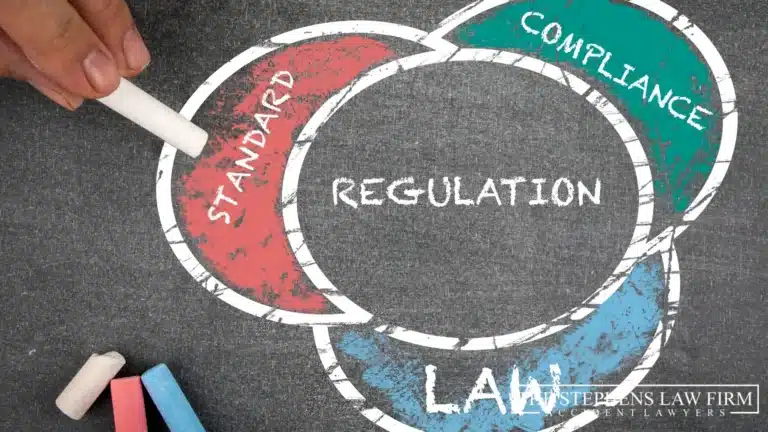
- Federal Motor Carrier Safety Regulations (FMCSR) set the standards for truck drivers and companies to follow, ensuring safety and reducing accidents. These rules apply to commercial vehicles operating across state lines in interstate commerce.
- Common FMCSR regulations include driver qualifications (age, medical requirements, commercial license), vehicle safety standards (working brakes, lighting, reflectors), and driving hours (limits on on-duty hours, 11-hour consecutive driving limit, updated logbooks).
- Truck companies must adhere to additional regulations like proper lane changes, speed limits, following distances, and regular drug and alcohol testing.
- Violations of these regulations often lead to accidents. Lawyers investigate these violations to help prove fault and secure additional compensation beyond standard damages if the driver or company is at fault.

Federal & State Rules for the Trucking Industry
Driving a huge 18-wheeler is no small task. Without trucking regulations, the number of fatal accidents on the road would increase significantly. The Federal Motor Carrier Safety Regulations (FMCSR) provide rules that truck drivers and companies must follow. The purpose of these rules is to set a standard for truck driving and minimize danger.
If you have been in a wreck and have a case against a driver or company, you will likely hear about the FMCSR. To prove that the driver is at fault, your lawyer will seek evidence that the company or driver violated federal or state rules. If the trucking company or operator violated a state or federal regulation you might be entitled to additional compensation.
Important Regulations for Truck Drivers in Texas
The Federal Motor Carrier Safety Regulations apply to employers and drivers who operate commercial motor vehicles (CMVs) in interstate commerce. However, even for trucks that never leave the state of Texas, the Texas Department of Public Safety (DPS) adopts and enforces similar intrastate rules.
These regulations are designed to reduce crashes, and identifying a violation is often the “smoking gun” in a personal injury lawsuit.
Driver Qualification Requirements Under FMCSR §391
Federal regulations require commercial truck drivers to meet strict qualification standards. These include minimum age requirements (21 for interstate), a valid Commercial Driver’s License (CDL), and medical fitness. New for 2025-2026: Texas DPS has increased enforcement of English Language Proficiency reviews to ensure drivers can effectively communicate with officials and understand Texas road signs.
Rules Governing the Operation of Commercial Vehicles Under §392
This section regulates how a CMV must be operated on public roads. It mandates pre-trip and post-trip inspections and prohibits drivers from operating a vehicle while their ability is impaired by fatigue, illness, or drugs. It also covers the safe loading and securing of cargo to prevent “unsecured load” accidents.
Commercial Vehicle Safety Equipment Requirements Under §393
Trucks must be equipped with functioning safety components, including brakes, lighting, tires, and reflective devices. Update: As of 2025, many newer heavy-duty trucks are now required to have Automatic Emergency Braking (AEB) systems. If a company fails to maintain these advanced safety technologies, it may be used as evidence of mechanical negligence.
Hours of Service and Driver Logbook Rules Under §395
To prevent driver fatigue, one of the top causes of fatal accidents, HOS rules limit daily and weekly driving hours. Drivers must use Electronic Logging Devices (ELDs) to record their duty status accurately. Note: While federal rules limit driving to 11 hours, Texas intrastate rules allow up to 12 hours of driving, making it critical to know which set of rules applies to your specific case.
Safe Driving Practices and Variable Speed Limits
Beyond basic traffic laws, truck drivers are held to a “professional” standard. They must avoid distracted driving (texting is strictly prohibited) and adjust speed for the weather. New Texas Law (HB 1885): Texas now uses dynamic speed limits in construction zones and during severe weather. Commercial drivers are legally required to obey these temporary signs even if the “normal” speed limit is higher.
Drug and Alcohol Testing Requirements for Truck Drivers
Federal regulations prohibit truck drivers from operating commercial vehicles while under the influence of drugs or alcohol. Trucking companies are required to conduct testing before employment, after certain accidents, at random intervals, and when there is reasonable suspicion. Allowing impaired drivers on the road puts the public at extreme risk.
Preventing “Chameleon Carriers” and Business Registration Texas Update (HB 1672)
As of May 2025, the state has new powers to revoke registrations and “pierce the corporate veil” to stop “chameleon carriers”—dangerous companies that shut down and reopen under a new name to hide their safety violations. This ensures that companies cannot outrun their history of negligence.
Required Truck Inspections and Ongoing Maintenance
Commercial trucks must undergo regular safety inspections, including annual inspections and routine checks before and after trips. These inspections are meant to identify mechanical issues before they lead to equipment failure. Skipped or falsified inspections can be a strong indicator of negligence in a truck accident case.
You can review the complete Federal Motor Carrier Safety Regulations through the Federal Motor Carrier Safety Administration. While some exemptions exist, many states also adopt these rules for intrastate trucking operations.
Get Legal Help After a Truck Accident
If you have been injured in an 18-wheeler accident, you should find an experienced lawyer to help you with your case.
When you or a loved one gets injured, the last thing you want to worry about is motor vehicle laws. A Texas commercial truck accident attorney in West Houston, like the Stephens Law Firm Accident Lawyers, can take these matters off your hands. You deserve compensation for your accident. Call today for a free consultation.

From fatigued drivers to poorly maintained rigs, we know what causes these crashes—and how to hold the right people accountable. Joe Stephens can help you fight for your recovery.
Commonly Reported Truck Driver Violations Cases We Handle
At The Stephens Law Firm, we represent victims of accidents caused by a wide range of regulatory failures. Common violation-based cases we handle in West Houston and across Texas include:
- Falsified Logbooks: Drivers who go over their hours and hide it.
- Overweight Loads: Trucks that exceed weight limits, making them impossible to stop in an emergency.
- Improper Maintenance: Wrecks caused by “bald” tires or worn-out brake pads.
- Negligent Hiring: Companies that hire drivers with a history of DUIs or multiple safety violations.
- Unsecured Cargo: Accidents caused by falling debris or shifted loads.
Call The Lawyer Who Wins Truck Accident Lawsuits
When your case requires the skill and knowledge of a top rated West Houston vehicle accident lawyer, Joe Stephens is the expert you’re looking to work with. Having tried over 100 cases to a successful verdict, he has a solid reputation for stalwart representation for his clients. Cases involving commercial truck wrecks can be very complex and present difficulty proving negligence of the truck driver, the trucking company, or both. The Stephens Law Firm has a reputation to represent professionally those families that have lost someone in truck accidents, as a negligent death attorney, Joe’s experience with these cases allows him to get right to the heart of the matter, his clients rights, and owed compensation.